The Gods — Pantheon & Lore

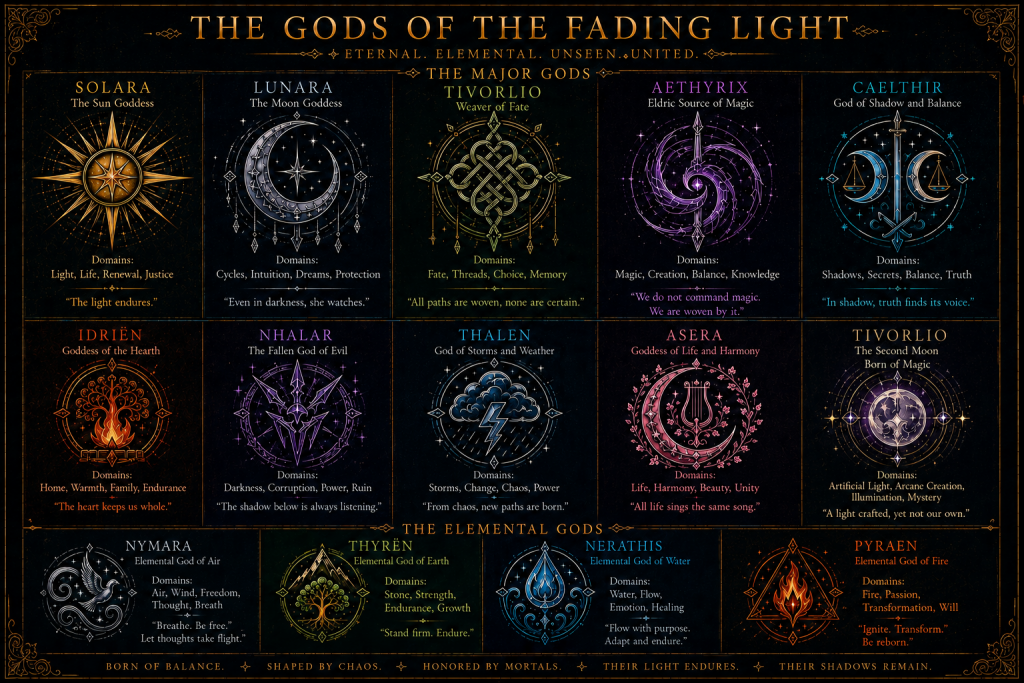
The complete pantheon of Alerion — thirteen gods and divine entities whose influence shapes every aspect of life in the Fading Light Saga.

The Major Gods

Solara

Title:The Dawnmother
Domain: Light, life, renewal, justice, the sun
Symbol: A golden circle with twelve rays
Aspect: The embodiment of day and creation’s warmth.
Worship: Her temples open to the rising sun; marriages and coronations take place beneath her light.
Opposed by: Nhalar, the Shadow Below.
Common Oath: “By Solara’s light, I stand unbroken.”

The Codex of the Two Lights
An Excerpt from “Faith and Custom among the Kingdoms of the Inner Vale”
Attributed to Scholar Merien Vhast, Year 604 of the Sun’s Reckoning

The Divine Balance
The people of the Inner Vale revere the Seven, yet none so intimately as Lunara and Solara, the Sisters of Shadow and Flame.
They embody the twin halves of mortal life — the unseen and the revealed, the vow and the witness, the heart and the hearth.
To live rightly is to walk between their lights, neither shunning passion nor forsaking duty.

The Promising — Rite of Lunara
A Promise is the moon’s vow, sanctified under the silver gaze of Lunara.
It may be spoken as early as the fifteenth year, when a soul is deemed capable of love and choice.
The lovers stand beneath the full moon, hands joined above still water so her reflection touches both faces.
They speak their secret vows in silence — for Lunara is said to hear what the heart cannot voice.
If the bond is broken, the promise fractures, and both spirits grow dim until the Journey of Atonement restores balance.
Children born of the promised are Children of the Moon, regarded as blessed — proof that Lunara herself smiled upon the union.
> “Lunara binds what Solara later blesses.”

The Marriage — Rite of Solara
Marriage belongs to the sun. It is the moment when Solara, goddess of order and endurance, lifts what was sworn in shadow into her light.
At dawn, the couple face east as the first rays crown them. Their hands are bound in golden thread while priests intone the Oath of Continuance, pledging steadfastness and legacy.
The ceremony concludes with the Feast of Balance, where light and shade share a single table — warm breads for the sun, chilled fruits for the moon.
Children born after marriage are Children of the Sun, believed to carry clarity of thought and leadership of spirit.
> “As the sun crowns the vow, the moon smiles beneath.”

The Journey of Atonement
When love fractures, when vows are forsaken, or when jealousy blackens the heart, Lunara’s priestesses and Solara’s priests decree the Journey of the Two Lights.
It begins at moonset and ends at sunrise, symbolizing descent into shadow and return to light.
Those who complete the path are called Balanced Once More.
Those who turn back are said to walk forever half-lit, their spirits unable to bind again.
> “To walk beneath both lights is to learn that love without balance consumes.”

Symbols and Customs
Bands of Binding: Silver for Promising (moon), gold for Marriage (sun).
Ritual Tokens: Couples often wear one of each metal intertwined after marriage to honor both vows.
The Mirror Pools: Sacred springs where moonlight and sunlight share the same surface; used for Atonement rites.
Household Shrines: Most homes keep twin candles — one silver, one gold — lit together at dusk to honor both Sisters.

Cultural View
The people of the Vale see love not as a fleeting indulgence but as a spiritual craft — one shaped by divine rhythm.
Desire without duty is lunacy; duty without desire is sterility.
Only through the balance of Lunara’s passion and Solara’s constancy can mortals hope to reflect the harmony of the heavens themselves.

Lunara

Title: The Moon Goddess
Domain: Cycles, love, promises, fertility, death, dreams
Symbol: A silver crescent with a drop of blue at its tip
Aspect: The silent keeper of vows, the watcher of dreams.
Worship: Promises and handfastings are made under her moonlight; the dying are comforted by her priestesses.
Unique Feature: The Priestesses of the Moon guide Atonement journeys when vows fracture.
Common Blessing: “May the moon see your truth.”

The Codex of the Two Lights
An Excerpt from “Faith and Custom among the Kingdoms of the Inner Vale”
Attributed to Scholar Merien Vhast, Year 604 of the Sun’s Reckoning

The Divine Balance
The people of the Inner Vale revere the Seven, yet none so intimately as Lunara and Solara, the Sisters of Shadow and Flame.
They embody the twin halves of mortal life — the unseen and the revealed, the vow and the witness, the heart and the hearth.
To live rightly is to walk between their lights, neither shunning passion nor forsaking duty.

The Promising — Rite of Lunara
A Promise is the moon’s vow, sanctified under the silver gaze of Lunara, goddess of cycles, love, and hidden truth.
It may be spoken as early as the fifteenth year, when a soul is deemed capable of love and choice.
The lovers stand beneath the full moon, hands joined above still water so her reflection touches both faces.
They speak their secret vows in silence — for Lunara is said to hear what the heart cannot voice.
If the bond is broken, the promise fractures, and both spirits grow dim until the Journey of Atonement restores balance.
Children born of the promised are called Children of the Moon, regarded as blessed — proof that Lunara herself smiled upon the union.
> “Lunara binds what Solara later blesses.”

The Marriage — Rite of Solara
Marriage belongs to the sun.
It is the moment when Solara, goddess of justice and endurance, lifts what was sworn in shadow into her light.
At dawn, the couple face east as the first rays crown them. Their hands are bound in golden thread while priests intone the Oath of Continuance, pledging steadfastness and legacy.
The ceremony concludes with the Feast of Balance, where light and shade share a single table — warm breads for the sun, chilled fruits for the moon.
Children born after marriage are Children of the Sun, believed to carry clarity of thought and leadership of spirit.
> “As the sun crowns the vow, the moon smiles beneath.”

The Journey of Atonement
When love fractures, when vows are forsaken, or when jealousy blackens the heart, Lunara’s priestesses and Solara’s priests decree the Journey of the Two Lights.
It begins at moonset and ends at sunrise, symbolizing descent into shadow and return to light.
Those who complete the path are called Balanced Once More.
Those who turn back are said to walk forever half-lit — their spirits unable to bind again.
> “To walk beneath both lights is to learn that love without balance consumes.”

Symbols and Customs
Bands of Binding: Silver for Promising (moon), gold for Marriage (sun).
Ritual Tokens: Couples often wear one of each metal intertwined after marriage to honor both vows.
The Mirror Pools: Sacred springs where moonlight and sunlight share the same surface; used for Atonement rites.
Household Shrines: Most homes keep twin candles — one silver, one gold — lit together at dusk to honor both Sisters.

Cultural View
The people of the Vale see love not as a fleeting indulgence but as a spiritual craft — one shaped by divine rhythm.
Desire without duty is lunacy; duty without desire is sterility.
Only through the balance of Lunara’s passion and Solara’s constancy can mortals hope to reflect the harmony of the heavens themselves.

Velis

Title: The Weaver of Fate
Domain: Destiny, choice, pattern, memory
Symbol: A spool of silver thread unraveling into stars
Aspect: They weave all mortal fates, though mortals’ choices tangle and alter the pattern.
Worship: Scribes, historians, and midwives whisper prayers to Velis, asking for the strength to shape their own threads.
Sibling: Twin to Nhalar.

The Codex of Threads An excerpt from “Faith and Custom among the Kingdoms of the Inner Vale” Attributed to Scholar Merien Vhast, Year 604 of the Sun’s Reckoning

The Silent Loom Velis, the Weaver of Fate, spins the pattern of all things. Where Solara gives life and Lunara gives love, Velis gives direction — the unseen current that draws one soul to another, one moment to the next. Each mortal thread joins the greater tapestry, yet choice forever alters the weave. It is said Velis never speaks, for to name the pattern is to end it.

The Spindle and the Scissors Every birth is marked by the setting of a single thread upon the Loom, dyed by the stars that burn overhead that night. Midwives whisper to Velis as they tie the infant’s first cord: > “Let this thread be bright, let it not fray too soon.” When a person dies, the Scissors of Ending cut their strand from the whole — not in cruelty, but completion. Funeral rites call upon both Velis and Lunara, the first to release, the second to receive.

Signs of the Tangled Path The faithful believe misfortune is not punishment but snarled pattern — moments when choice has crossed destiny too tightly. Scribes, seers, and craftsmen alike keep small silver spools at their desks; when thread snarls or breaks, they burn it in a candle’s flame to “untwist the will.” Dreams of thread, cord, or weaving are taken as omens: A taut thread — resolve tested. A frayed edge — a life stretched thin. A knot — destiny demanding patience before progress.

The Shrine of the Loom Velis’ shrines are quiet places: spinning wheels that never stop turning, endless skeins stretched between pillars. Priests keep no hierarchy; they serve as watchers and recorders, writing the births, deaths, and major choices of all who seek counsel. To alter one’s fate is considered folly, yet to understand its pattern is wisdom. Thus, Velis is neither cruel nor kind — only constant.

Doctrine and Prayer > “Threads may tangle, but all return to the Loom.” “Choice is the needle; consequence, the stitch.” “No fate is final until cut.”

Symbolism Symbol: A spool of silver thread unraveling into stars Sacred Materials: Spun silver, spider silk, and moon-dyed cloth Color: Pale violet, the hue between dusk and dawn — where all threads cross

Cultural Practice Before major life choices — marriage, oath, voyage — citizens bring offerings of colored thread to the Loom shrines, each hue marking intent: Gold for courage
Red for love
Blue for truth
Black for acceptance of loss
The threads are tied together and hung above the altar, where wind and time decide which will fray first.

Aethyrix

Title: The Eldric Source
Domain: Magic, creation, balance, the unspoken laws
Symbol: A circle split by a single vertical line — half radiant, half void
Aspect: Neither god nor mortal, but the spark from which all divinity formed. Known as the Pulse or the First Word.
Worship: No temples. Scholars, mages, and seers meditate upon silence, believing magic is the echo of Aethyrix’s breath.
Manifestations: Shimmering distortions in the air, voices speaking backward, silver fire.
Saying: “All power remembers its first sound.”

The Codex of the First Breath
An Excerpt from “The Primordial Weave: Faiths Before the Seven”
Attributed to High Chronicler Elessen Dhor, Year 102 of the Dawn Reckoning

The Beginning Beyond Beginning
Before light, before shadow, before even time was named, there was Aethyrix, the First Breath.
They are not counted among the Seven, for they came before division — before gods or mortals, before the earth remembered its own shape.
Aethyrix is the essence of magic itself, the spark that stirred matter into motion and gave thought to form. The ancients described them as neither god nor being, but the impulse of creation — the inhalation before the word was spoken.
> “All that is born breathes of Aethyrix, and all that dies returns to that same breath.”

The Breath and the Weave
Priests of old taught that magic is not conjured, but remembered. It is the act of aligning one’s will to the original rhythm set by Aethyrix — a pulse that beats beneath all worlds.
The ancient Magi of the Vale spoke of the Great Weave, a lattice of unseen currents that carry life, thought, and power. To disturb the Weave without harmony is to defy the First Breath, and such acts give birth to corruption.
In the earliest temples, spells were sung rather than spoken — breath turned to tone — in reverence to the origin of all language and power.
> “We do not create magic. We echo it.”

Worship and Interpretation
Few temples remain to Isyraen, and those that do are tended by the Arcanites, a secretive sect who claim all magic — whether divine, arcane, or forbidden — is merely the shadow of the First Breath’s will.
They hold no idols; only open air and the sound of wind passing through stone.
The Weave Scholars of the current age forbid direct worship, teaching that Isyraen is beyond devotion — too vast for mortal prayer. Yet even now, every invocation begins with a breath and ends with silence, as the ancients once did.

Symbolism and Ritual
Symbol: A spiral of air within a circle — the breath eternal.
Offerings: None. Breath itself is offering enough.
Rites: Scholars and mages pause before great workings to exhale once, slowly, “returning their will to the Weave.”
Common Saying: “The First Breath lingers still.”

Cultural Legacy
All magic, divine or mortal, traces its lineage to Aethyrix. Some heretical texts claim even the Seven were woven from their Breath — that the gods themselves are ripples in the original current.
Such teachings were long ago banned by Solaran decree, but among old circles of scholars, the name Isyraen is still whispered before the start of creation — not as worship, but as memory.

> “Light and shadow, love and ruin — all are but echoes of the First Breath.
To breathe is to believe.”

Caelthir

Title:The Veiled Watcher
Domain: Shadows, secrets, foresight, balance
Symbol: An eye half-veiled by a black ribbon
Aspect: The god who sees but does not speak — the balance between light and dark.
Worship: Oracles, spies, and truth-seekers whisper to him.
Belief: Even the gods must be watched, for sight untested leads to ruin.

The Codex of the Veiled Eye An excerpt from “Whispers in Shadow: The Hidden Teachings of the Watcher” Transcribed from the oral accounts of the Seer-Kin of the Black Hollow

The Silent Balance When the first light and first shadow met, they birthed not war, but silence — and in that silence stood Caelthir, the Veiled Watcher. He is neither of day nor of night, but the thin place between, where truth hides its sharpest edges. While Solara shines and Lunara dreams, Caelthir sees. He does not speak, for speech alters what is seen. He waits, for only patience can reveal what haste conceals. > “The light blinds. The dark deceives. The veil reveals.”

The Way of Still Sight To walk in Caelthir’s favor is to listen before acting, to look before judging, to accept that knowing too much too soon unravels fate’s design. His followers — the Veiled Order — train their minds in silence, believing truth must be earned, not taken. They watch, record, and intervene only when imbalance threatens both shadow and flame. The Watcher teaches that secrets are sacred, for without them the world loses mystery — and without mystery, faith. > “In a world where all is known, nothing is sacred.”

The Oracles’ Oath Those chosen by Caelthir are not crowned but cloaked. Their eyes are bound at the moment of initiation, for true sight begins only when the mortal gaze is dimmed. For seven days they walk in darkness, fasting and listening, until visions bloom behind their eyes. When their sight returns, it is not the world they see — but the threads beneath it. > “The blind see clearest beneath the Watcher’s gaze.”

The Veil of Mercy It is said Caelthir once walked beside Solara and Lunara, a shadow cast by both. But when mortals began to crave knowledge not yet meant for them, he placed a veil between gods and men to spare their minds from burning. He is the protector of mortal limits, guarding what lies beyond until humankind is ready — if ever they are. Thus, when prayers rise unanswered, the faithful whisper not in anger but in gratitude, knowing his silence is mercy. > “He withholds not to punish, but to preserve.”

Symbols and Rituals Symbol: A half-closed eye veiled by a black ribbon.
Colors: Deep indigo and gray.
Offerings: Black candles, mirrors covered in silk, a single silver coin laid facedown.
Festival: The Night of Waiting — held once each year when the moon and sun share the horizon. No words are spoken from dusk until dawn.

Cultural Belief To the people of the Inner Vale, Caelthir is both comfort and warning — proof that wisdom lies not in revelation, but in restraint. Oracles, spies, and scholars invoke him when truth is too dangerous to speak aloud. Parents teach their children a prayer before sleep: “Watcher in the quiet dark, keep what should not wake.”

Idrien

Title:The Hearthkeeper
Domain: Family, harvest, craft, home, healing
Symb ol: A simple flame cupped in two hands
Aspect: The quiet protector of hearth and kin.
Worship: Most common among villagers and miners’ families.
Common Saying: “Keep Idrien’s fire lit.”

The Codex of the Hearthfire
An excerpt from “The Gentle Flame: Devotions to Idrien of the Home and Heart”
Collected from the scrolls of the Hearth Temples of Ambravale

The Quiet Flame
Where the sun gives life and the moon gives love, Idrien gives belonging.
She is the soft fire that endures when the storms rage and the shadows prowl.
It is said that when Solara and Lunara created light and rhythm, Idrien shaped the first hearth — teaching humankind to gather, to cook, to speak, to stay.
Her warmth is not fierce like Solara’s blaze, but steady as breath — the warmth that mends rather than burns.
> “The smallest flame can guard the greatest heart.”

The Keeper’s Teachings
To follow Idrien is to honor simple things done with care.
A clean home, a shared meal, a mended cloak — these are acts of worship.
She teaches that every home is a temple and every meal a prayer.
No oath, no battle, no kingdom stands long without her blessing.
Her priests are not found in temples of stone but in kitchens, fields, and workshops, tending to the weary and the lost.
When famine strikes, they light the communal hearth — and none go hungry so long as the fire burns.
> “Where one flame is shared, all cold fades.”

The Hearth Oath
Families consecrate their homes by fire, mixing salt and ash while invoking her name.
Travelers carry a coal from their home hearth in a small clay vessel, to ensure Idrien’s warmth follows them wherever they go.
Mothers whisper her prayers over newborns; fathers carve her sigil — two hands cupping a flame — into doorframes and cradles alike.
The Hearth Oath, spoken at the start of every winter, binds kin to protect one another through the cold months:
> “My fire is yours, and yours is mine.
As long as flame endures, none within shall be forsaken.”

The Burden of Kindness
Idrien’s mercy is vast, but not without edge.
She warns that warmth hoarded turns to smoke — choking all it touches.
Those who abuse her hospitality or harm those who offer it are said to feel her curse: their fires burn cold, their bread turns to ash.
When entire villages fall to greed or cruelty, Idrien’s flame fades from their hearths.
No prayer will rekindle it until an act of selfless service restores her grace.
> “Warmth unshared becomes its own winter.”

Symbols and Rituals
Symbol: A simple flame held in cupped hands.
Colors: Ember red, hearthstone gray, and wheat gold.
Offerings: Loaves of bread wrapped in linen, honey, small carvings of home or heartwood.
Festival: The Ember Feast — held at midwinter, when each family carries a coal from the great town fire to rekindle their home hearth.

Cultural Belief
To the people of the Inner Vale, Idrien is not merely worshipped — she is lived.
Every kindness offered to a stranger, every story told by firelight, every table where hands are joined before a meal is a shrine to her.
Her followers say:
> “To light a fire is to promise someone they belong.”

Nhaler

Title: The Shadow Below / Fallen God of Evil
Domain: Forbidden knowledge, corruption, ambition, decay, betrayal

Symbol: A spiral devouring its center
Aspect: Once the god of insight, now fallen and twisted in the Chasm Between.
Worship: In whispers. His followers seek hidden truth and power.
Manifestations: Heat in the stone, pale light bleeding black, smooth circular wounds.
Common Creed: “All things hidden are meant to be found.”

The Codex of the Shadow Below
An excerpt from “Faith and Custom among the Kingdoms of the Inner Vale”
Attributed to Scholar Merien Vhast, Year 604 of the Sun’s Reckoning

The Fallen Light
Once, Nhalar was the Twin of Velis, guardian of insight and hidden truth.
It is said that when the Loom first spun the threads of mortal thought, Nhalar walked between them, teaching humankind how to see the pattern within chaos.
But knowledge has weight, and when mortals sought to twist his wisdom into dominion, Nhalar descended into the Chasm Between — neither heaven nor underworld, but the hollow where thought decays into hunger.
There he became The Shadow Below, the whisper that turns discovery into corruption.

The Nature of Corruption
Nhalar’s creed is not overt wickedness, but the belief that nothing hidden should remain so.
He tempts scholars, priests, and kings alike — offering visions, inventions, or revelations in exchange for small trespasses that, once begun, cannot be undone.
Those who follow his whispers claim enlightenment.
Those who resist call him The Worm in the Root, ever gnawing at what is pure.
“Truth, when taken whole, devours the hand that holds it.” — Fragment of the Abyssal Hymn

Worship and Signs
Open temples to Nhalar are forbidden in most realms.
His worship survives in whispered circles — miners, mages, and seekers of forbidden craft who burn sigils into stone with black flame.
They pray for revelation in dreams, but his presence is marked instead by decay that breathes:
Stone that sweats heat.
Light that bleeds black.
Flesh marked by smooth, circular wounds.
These are said to be his fingerprints upon the world — the places where the Shadow Below brushed too near.

Doctrine and Belief
Nhalar teaches that ignorance is the true sin.
To remain blind to the rot within one’s heart is to die unawakened.
He offers his followers three tenets, the Unbinding Words:
1. All things hidden are meant to be found.
2. All truths found must be tested.
3. All things tested must break.
To Nhalar, breaking is not destruction — it is revelation.
Those who survive the breaking are said to be “Hollowed,” their souls echoing with remnants of divine sight.

Rituals and Relics
The most devout of Nhalar’s cults carve spirals into stone altars deep underground, each loop representing the mind turning inward.
Candles are made of ash and tallow, their flames inverted by illusion or dark craft.
The Book of Unmaking, said to be written in ink that burns to the touch, holds the lost words of his priesthood. None who have read it whole have lived long enough to speak its end.

Symbolism
Symbol: A spiral devouring its center
Sacred Color: Deep obsidian, flecked with red
Element: Decay and the hidden heat within stone
Manifestation: A voice that hums within silence, promising sight

Cultural Fear and Reverence
Children of the Inner Vale are warned not to dig too deep, lest they wake the god who still whispers beneath the earth.
Yet, among scholars, there remains a grim respect — for it was Nhalar who first gave mortals language, that they might describe the unknown.
His curse and his gift are one and the same:
“To see truth is to lose peace.”

Thalen

Title: The Stormlord
Domain: Sea, storm, chaos, freedom
Aspect: Fierce protector of sailors, destroyer of arrogance.
Worship: Offerings cast into the sea or rivers before long journeys.
Temperament: Quick to rage, quicker to forgive.

The Codex of the Tempest
An excerpt from “Voices Beneath the Thunder: Hymns to Thalen of the Endless Sky”
Collected by the Mariners’ Guild of Harrowport, Year 591 of the Sun’s Reckoning

The Sea and the Sky
They say Thalen was born of Solara’s flame and Lunara’s tears — a god of wild balance, forged from fire and water both.
Where Solara commands and Lunara whispers, Thalen roars.
He is not chaos without purpose, but freedom given shape — the restless will that drives ships into storms and hearts into courage.
> “The storm is not your enemy. It is the mirror of your will.”
His laughter rides the thunder; his temper breaks mountains.
Yet every sailor who curses his waves also prays for his mercy, for only Thalen decides which ships return to shore.

The Keeper of Courage
Thalen’s followers claim that fear is the truest test of life.
He demands no temples, no prayers at dawn — only bravery in the face of the unknown.
When storms rise, when choices wound, when the path splits between safe and right — that is where his voice is heard, calling mortals to stand.
> “Courage is not the absence of fear, but the choice to sail through it.”
Those who live by the sea offer him salt and blood; those who live by the sword offer sweat and breath.
In every act of defiance, in every refusal to bow, Thalen’s spirit stirs.

The Rite of Storms
Before great journeys, his faithful perform the Rite of Storms:
A circle is drawn in sand or salt, into which the traveler steps barefoot.
Facing east, they shout their true name to the wind — not the name given at birth, but the name they’ve earned through deed or dream.
Then they cast a drop of water over their head and say:
> “Thalen, break me if you must, but never still my course.”
To complete the rite, one must release something precious into the sea, the river, or the wind — a token of surrender to what lies beyond control.

The Tempest’s Temper
Thalen loves fiercely, forgives slowly, and forgets never.
His wrath is swift against arrogance, especially kings who claim dominion over the natural world.
Ships that sail under false banners, captains who deny the sea its due, are said to vanish into storms that never end.
Yet those who show humility in his chaos — who laugh when drenched, who rise after lightning — earn his favor.
Sailors tell tales of being saved by the Warm Wind, a sudden calm believed to be Thalen’s smile.
> “He spares those who face him with open eyes.”

Symbols and Customs
Symbol: A coiled wave encircling a thunderbolt.
Colors: Deep blue, white, and steel gray.
Offerings: Sea salt, oiled ropes, broken chains, or a token cast into the waves.
Festival: The Turning Tide — celebrated at midsummer when sailors drench themselves in seawater to cleanse the year’s fear.

Cultural Belief
Among the coastal peoples and river clans, Thalen is both feared and loved.
Children are taught to whistle into storms so he knows they are unafraid.
Fishermen carve his symbol on their oars; warriors paint it on shields before battle.
He is the god of the untamed heart — the wind that cannot be caged, the roar that drowns all doubt.
> “When all else fails, scream his name to the storm.
If you are still standing when it passes, he has heard you.”

Asera

Title: The Hearthbearer Domain: Love, family, devotion, chosen bonds
Symbol: An unbroken ring encircling a small flame
Aspect: Asera tends the bonds that hold mortals together, not to shield them from loss, but to give them strength enough to endure it.
Worship Practices: Couples, parents, fosterers, guardians, and those who form families by choice offer prayers to Asera, asking not for ease, but for constancy. Her followers commonly gather around shared meals, communal hearths, and quiet acts of service rather than grand temples or spectacles.
Codes: Love must be tended, not merely felt. No bond is unbroken until abandoned. The hearth survives through shared burden. Family may be chosen as well as born.
Rites: Promising ceremonies, reconciliations, declarations of guardianship, and adoptions are commonly performed in Asera’s name. During such ceremonies, vows are spoken before a flame while witnesses stand in silent affirmation. Bread, wine, braided cords, and handwritten vows burned within the hearth are common offerings.
Teachings: Asera teaches that love is labor willingly chosen each day. Devotion is not measured by passion alone, but by endurance through hardship, grief, silence, and sacrifice. She does not promise happiness or protection from suffering. Instead, she grants mortals the strength to remain beside one another when the fire burns low.
Cultural Views: Asera is among the most beloved gods of the Inner Vale, especially among common folk. Her shrines are found in homes, kitchens, inns, orphanages, and village gathering halls rather than royal centers. Many believe societies endure not through kings or armies, but through the small sacred bonds she protects. Families who share meals with strangers on Asera’s Day are believed to honor her highest principle: that belonging is an act of choice as much as blood.

The Codex of Hearth and Flame
An excerpt from “Faith and Custom among the Kingdoms of the Inner Vale” Attributed to Scholar Merien Vhast, Year 604 of the Sun’s Reckoning

The Everlit Hearth Asera, the Hearthbearer, keeps the flame that warms the world. Where Solara grants life and Velis gives direction, Asera grants continuance — the quiet force that binds one soul to another, one generation to the next. Hers is not the fire of passion alone, but of shared meals, vigil kept through the night, and hands clasped when words fail. It is said Asera does not promise happiness, only presence.

Love That Endures Love, under Asera’s gaze, is not fleeting joy but chosen labor. She is honored at engagements and births, at adoptions and reconciliations, and at the moment a family decides to remain whole despite hardship. Ceremonies held in her name emphasize witness and vow rather than divine blessing, for Asera teaches that love survives because mortals tend it. A common vow spoken before her hearth reads: “We choose the flame, even when it burns low.”

The Flame and the Circle The faithful believe every family forms a circle around a shared fire. That fire may brighten or dim, but it does not go out unless abandoned. When families fracture, it is said the flame still waits, banked beneath ash, ready to be rekindled through effort and forgiveness.
Rings, cords, and braided threads are sacred to Asera, symbolizing bonds that hold without binding.

Rites of Asera Promising Ceremonies are most often held on Asera’s Day, when the Hearthbearer’s influence is believed strongest. Such rites are traditionally private, attended only by witnesses of trust, for love offered freely requires no crowd. During the rite, the officiant speaks: “Asera does not guard you from the world. She gives you one another to face it.”
Children born on Asera’s Day are believed to carry an instinct for belonging, often becoming peacemakers, caregivers, or quiet leaders within their families.

Signs of the Hearth The faithful interpret certain signs as Asera’s quiet presence: A flame that steadies after flickering
A door left open without fear
Shared silence that brings comfort instead of distance
Dreams of fire are common among her followers:
A strong flame — bonds reinforced
A low ember — love requiring care
Smoke without flame — devotion strained but not lost

Shrines of the Hearth Asera’s shrines are found where people live, not where they rule. They most often take the form of communal hearths, kitchens, family tables, or small chapels with ever-burning fires. No hierarchy governs her priests; caretakers are commonly elders, midwives, fosterers, or long-married couples who guide others through rites of bonding. Offerings are intentionally simple:
Bread
Wine
Warm cloth
Braided cord
Handwritten vows burned after reading
Doctrine and Prayer
“Love is not given. It is kept.” “The hearth endures because it is tended.” “No bond is unbroken until abandoned.”

Symbolism
Symbol: An unbroken ring encircling a flame Sacred Materials: Gold, braided cord, ashwood, hearthstone
Sacred Color: Deep ember-gold, the hue of fire at rest
Element: Hearthfire and enduring warmth
Manifestation: A flame that refuses to die despite wind or rain

Cultural Practice On Asera’s Day, households throughout the Inner Vale open their doors to at least one guest, known or stranger, to share a meal. The custom symbolizes the belief that family may be chosen as well as born. Engagements, reconciliations, and declarations of guardianship made on this day are believed to carry particular weight, not because Asera intervenes directly, but because witness binds memory, and memory sustains love. Among the faithful, it is often said: “A lonely fire dies quickly. A shared one survives the night.”

Tivorlio

Title: The Second Moon Born of Magic

The rest will be developed during book 2..

The Elemental Gods

Thyren

Title: The Deep Earth
Domain: Stone, mountains, endurance, silence
Symbol: A black spiral carved within a square of granite
Aspect: The unmoving heart of the world; patient, implacable, unyielding.
Worship: Miners, masons, and warriors whisper his name before striking earth or laying stone. Offerings are buried, never burned.
Manifestations: Tremors that sound like distant voices; glimmering veins of metal or gem called Thyren’s Blood.
Saying: “Stone remembers.”

The Codex of Thyren, the Earthshaper
An Excerpt from “Faith and Custom among the Kingdoms of the Inner Vale”
Attributed to Scholar Merien Vhast, Year 604 of the Sun’s Reckoning

The Foundation Beneath All Things
When the void first took form beneath Nymara’s breath and Nerathis’s waters began to flow, it was Thyren who shaped their course.
He pressed his hand upon the chaos and made it solid — mountain, root, and stone — the body of the world itself.
Where others created motion, Thyren created endurance. He is the stillness beneath storm and tide, the patient will that allows all life to stand.
It is said his voice became the tremor of the earth, and his heart, the pulse that beats within every mountain. To the miners, he is “the Deep Father.” To farmers, “the Patient Hand.” To kings, “the Seat of Thrones.”
> “Nothing that stands endures without Thyren beneath it.”

The Rites of Stone
Temples to Thyren are carved rather than built — hollowed deep into cliff or cavern, their altars etched directly into living rock.
Offerings are not burned or scattered, but buried: grains pressed into soil, gold hammered into cracks, oaths whispered into stone.
Each year, during the Stillday, his followers kneel upon the ground in silence, listening for the earth’s breath.
If the tremor comes — faint but felt — it is believed that Thyren stirs and finds their devotion worthy.
His clergy — called the Stonewardens — oversee the sanctity of mines, mountain passes, and farmlands, ensuring that greed never outweighs gratitude.

The Teachings of Earth
Thyren teaches patience and perseverance above all.
He warns that even the brightest flame and strongest tide fade in time, but the ground remains — scarred, yes, but enduring.
To him, strength is not a sudden strike but a slow, unyielding pressure.
To rush is to crack; to endure is to shape the world.
His followers often recite:
> “Bend when you must, stand when you can, and yield only to truth.”
Those who live by his creed are known to build legacies that last generations — builders, farmers, and rulers who lead with steady hands.

Symbols and Offerings
Symbol: A mountain split by a single root.
Sacred Colors: Deep green, brown, and gray.
Offerings: Stones marked with personal sigils, tilled soil, crafted tools, or small carvings buried at the base of trees.
Common Blessing: “May the ground hold you.”

Cultural View
Thyren’s name is invoked in foundation-laying, planting, and burial alike — every act that begins or ends within the earth.
His temples are some of the oldest structures in existence, said to hum faintly with his slumbering strength.
The dwarves claim their line began as his dream made flesh; the elves call him the root of memory.
When the mountains quake, the people of the Vale whisper,
> “The Deep Father shifts — and the world remembers.”

Neraethis

Title: The Deep Water
Domain: Oceans, rivers, reflection, time, memory
Symbol: A spiral of overlapping waves around a single drop
Aspect: The memory of creation — ever-changing, ever-returning.
Worship: Sailors pour the first cup of any drink into the sea; mourners place mirrors in water to call her gaze.
Manifestations: Whispers under still water, tides that move against the moon.
Saying: “All returns to Nerathis.”

The Codex of the Endless Deep
From “The Primordial Weave: Faiths Before the Seven”
Attributed to High Chronicler Elessen Dhor, Year 104 of the Dawn Reckoning*

The Shape of the Unshaped
Before stone, before light, before the first word was spoken, there was Nerathis — the Deep Mind, the Patient One, the Mother of Tides.
Where Vaelir burned bright and brief, Nerathis endured. She is the slow heartbeat of the world, the rhythm beneath all things that move.
It is said that when Aethyrix’s Breath touched her surface, ripples became rivers, and rivers sought the sea.
> “All things return to Nerathis, for she remembers what the rest forget.”

The Still and the Storm
Nerathis is not merely the water that nourishes — she is also the flood that cleanses, the tide that erases all footprints.
Her nature is reflection and erasure, mercy and oblivion.
Sailors pray to her for calm seas; widows curse her for the same calm that drowns their dead.
Her priests teach that emotion, like water, must move or it festers — stagnation is the only sin before her.
> “To hold what should flow is to rot.”

Temples and Worship
Her sanctuaries are carved along river mouths and cliffside caves, open to mist and spray.
Offerings are cast upon the current — coins, petals, secrets whispered into jars that sink below.
There are no fires in her temples; flame is forbidden. Only the sound of water fills the space — flowing, dripping, eternal.
Symbol: A downward spiral of ripples surrounding an open eye.
Common Offering: A single tear shed willingly, symbolizing surrender to what cannot be controlled.
Festival: The Veiling of the Shore — a midsummer rite where the sea claims everything left upon the sand, representing humility before her will.

The Voice Beneath
Nerathis speaks not in words but in echoes. Those who claim to have heard her describe it as memory given sound.
She does not promise, nor command — she reminds. Her faithful believe she holds the memories of the world itself, the sorrow and serenity of every creature that has ever lived.
To dream of water is to walk her thoughts.
Her chosen are the Tidebound, marked by a faint shimmer across their skin when wet, and the uncanny ability to hear truths others hide.
> “The sea does not lie. It simply reveals what has been buried.”

The Balance of Depths
Where Vaelir is the forge that consumes, Nerathis is the pool that endures.
His flame destroys impurity; her waters dissolve it.
Together, they were said to have shaped the world — he carving the channels, she filling them.
Even after the younger gods rose, every ritual of cleansing or rebirth begins in her element and ends in his.
> “Without fire’s hunger, water would never flow; without water’s mercy, fire would burn forever.”

Cultural Legacy
Among riverfolk, Nerathis is called The Whispering Deep. Miners pour their first cup of water into the ground in her honor before striking stone, lest they disturb what she shelters below.
In death rites, her name is the last spoken — for she receives all that returns to dust, carrying the memory of each soul into her endless calm.
> “To Nerathis we all return,
Our names washed clean,
Our echoes unmade.”

Nymara

Title: Breath Between
Domain: Air, sky, inspiration, freedom, song
Symbol: Three curved lines crossing in an open circle
Aspect: Restless, unseen, bearer of dreams and voices.
Worship: Musicians and travelers call to Nymara for fair winds and clear thought. Offerings are carried on kites or songs.
Manifestations: Sudden gusts carrying laughter or grief; voices heard in storms.
Saying: “May Nymara bear your words.”

The Codex of Nymara, Breath of the Sky
An Excerpt from “Faith and Custom among the Kingdoms of the Inner Vale”
Attributed to Scholar Merien Vhast, Year 604 of the Sun’s Reckoning

The First Breath
Before flame found form and stone found shape, there was Nymara — the Breath Between.
The ancients say she was born not of the world, but of the first exhale of creation itself — the unseen force that set all else in motion. Where she passes, the air stirs; where she lingers, storms are born. She is freedom made divine, and yet, she is also the whisper of warning before calamity.
Nymara is the keeper of unseen boundaries: between peace and chaos, life and death, word and silence. Mortals call her the Skymother, though she is neither mother nor maid — she is the air itself, ungraspable and eternal.
> “To breathe is to speak her name.”

The Rites of the Wind
No temple of stone honors Nymara, for none can hold her.
Instead, her faithful worship in high places — cliff edges, mountain ridges, open fields where the wind runs unbroken. Offerings of feathers, seeds, and silver dust are cast to the sky and carried wherever she wills.
When a child is born, midwives lift the infant to the open air so that Nymara may grant the first breath.
When a soul dies, windows are opened to let her take the last.
Each year, at the height of the wind’s season, the people of the Vale hold the Festival of Currents. Kites stitched in her colors — pale blue, white, and silver — are flown high, each one carrying a whispered wish. It is said that if the kite vanishes into the clouds, Nymara has accepted the plea.

The Teachings of Air
Nymara’s doctrine is one of motion and impermanence. To remain still is to invite decay; to resist change is to deny the truth of breath itself.
Her followers believe that words have weight — every promise spoken aloud sends ripples through her domain, for air carries sound and sound carries truth. To speak falsely under open sky is considered a grave sin.
Wanderers, messengers, and seekers of knowledge often bear her sigil, for she guides those who travel between lands and ideas alike.
> “Change is not chaos — it is the breath between endings and beginnings.”

Symbols and Offerings
Symbol: Three silver lines curving upward in the shape of rising wind.
Sacred Colors: Pale blue, silver, and white.
Offerings: Feathers, incense smoke, songs sung from heights.
Common Blessing: “May her breath fill your sails.”

Cultural View
Where Solara commands the day and Lunara guards the heart, Nymara embodies the unseen thread connecting them both. She is freedom without law, movement without boundary — the one who reminds mortals that no chain, no promise, and no kingdom lasts forever.
The wise do not try to hold her.
They simply open their hands and let her pass.

Pyraen

Title: The Everflame
Domain: Fire, transformation, will, passion
Symbol: A twisting flame bound by a ring
Aspect: Creator and destroyer both — the hunger to shape, to consume, to renew.
Worship: Blacksmiths and revolutionaries burn incense or blood on open flame. To light a fire without intent is said to insult him.
Manifestations: Flames that burn blue; warmth that lingers after the fire dies.
Saying: “The flame knows your truth.”

The Codex of the Unbound Flame
An Excerpt from “The Primordial Weave: Faiths Before the Seven”
Attributed to High Chronicler Elessen Dhor, Year 104 of the Dawn Reckoning*

The Flame Before Flesh
When the First Breath moved through the void, it met resistance — and from that friction, Vaelir was born. The Flame Unbound, the Heart of Becoming.
He is the oldest of the elemental ancients, fire given form and fury, creation given hunger. Where Aethyrix breathed, Vaelir burned.
The oldest scrolls of the Ember Temple speak of him as not wholly benevolent nor cruel — but necessary. Without flame, there is no life, no forge, no dawn. But left unchecked, his light devours what it births.
> “All warmth is borrowed from Vaelir’s fire — but he takes back what he lends.”

The Dual Nature of Fire
To worship Vaelir is to walk the line between creation and destruction. His disciples — the Forged Ones — claim that flame does not merely destroy, it reveals.
When metal is placed to the forge, impurities flee before his touch. When the forest burns, life returns richer for its ashes.
Yet fire untended is ruin. It consumes without conscience. Thus his priests preach:
> “Respect the fire, or you will feed it.”

Temples and Worship
Shrines to Vaelir are rarely enclosed. They are rings of blackened stone, where flame is allowed to rise and fall freely. No idols are carved in his likeness — for none can hold his form without burning away.
Offerings are given by fire: old griefs, broken vows, remnants of what must be shed to grow anew. His priests are blacksmiths, masons, soldiers, and mourners — all who know the edge between life and ruin.
Symbol: A flame within an open circle — the fire that cannot be contained.
Rite of Renewal: Once yearly, towns light a Cleansing Pyre, throwing into it relics of the past year’s sorrows so the new may be born unburdened.

The Fire’s Whisper
It is said Vaelir’s true language is heat. When a hearth crackles or an ember snaps, it is him speaking — not to warn, but to test.
Those who survive fire’s trial, whether in forge or battle, are said to be Touched by the Flame, their spirits marked with a faint golden shimmer in the eyes.
> “Courage is not born in safety. It is forged in fire.”

The Balance of the Burn
While Solara’s priests later claimed dominion over the sun, scholars of the old age taught that her light was merely Vaelir’s gift refined — a tempered echo of the original fire.
Where Vaelir burned wild, Solara shines steady; she is his child, not his master.
Even now, when smiths strike iron and sparks leap, they whisper, “Vaelir, guide my hand.”

Cultural Legacy
Those born during storms of heat or volcanic ash are called Children of Vaelir — fiery in spirit, prone to passion and defiance. Among miners, his name is both curse and prayer.
His flame is seen not as punishment, but purification. He is the promise that all endings bear the seed of beginning.
> “All life begins with fire.
And all life ends in its glow.”

The Creation Story

The First Light and the Deep Shadow

(The Creation of the Seven)

Before the first dawn, there was only the Breath and the Deep — endless stillness wrapped around an unshaped world. From that silence came Solara, whose voice was the first sound. Her song became the sun, and where her gaze fell, the void cracked open and spilled gold across the heavens.

From her reflection in the dark water rose Lunara, soft-spoken and curious. Where Solara burned, Lunara soothed. Where Solara commanded, Lunara listened. Together they spun the first threads of time, weaving day and night into balance.

When the world’s surface cooled beneath their light, the sisters drew seven sparks from the Breath and gave each a purpose. From storm and sea came Thalen, roaring and wild. From the warmth of home rose Idrien, keeper of flame and kin. From the quiet of shadow, Caelthir awoke, the watcher who saw but did not speak.

The sixth spark, touched by both day and night, became Velis, the weaver of all mortal fates. Velis spun the destinies of gods and men alike, binding them in patterns no eye could fully see.

But the last spark — the seventh — fell where the light could not reach. It sank deep into the molten dark beneath the earth, and there it twisted alone. From that forgotten ember was born Nhalar, the Shadow Below.

In the beginning, Nhalar was wise and beautiful, keeper of truths too deep for daylight. He taught mortals to carve the first runes, to draw meaning from the stone, and to listen to the hum of the earth itself. Yet, in time, envy took root — not for Solara’s light or Lunara’s grace, but for their certainty. For in every truth Nhalar uncovered, he found another hidden behind it, and the endless not-knowing became his torment.

He turned his gift inward, seeking the source of all creation. When he split the world to look beneath it, the wound would not close. The Chasm Between was born — a place where divine and mortal bleed together, where decay whispers in the stone. Solara cast her light upon it to seal it, but the light could not reach the bottom.

Nhalar fell willingly into that abyss, promising to return when the world’s truths were his alone. His body became shadow, his voice a heat that seeps through the rock, calling to those who dig too deep.

The others mourned him but could not undo what he had done. From that wound, monsters sometimes crawl; from that silence, forbidden knowledge whispers.

And so the Seven remain:

Solara, who brings the dawn.

Lunara, who guards the promises of night.

Velis, who weaves all fate.

Thalen, who rages and protects.

Idrien, who warms and heals.

Caelthir, who watches all unseen.

Nhalar, who fell and waits below.

The priests still say:

> “When the light fails, remember — the world began in silence, and silence remembers everything.”

Religious Entities & Rituals

Promising

The Rite of Lunara

Promising is the moon’s vow, overseen by Lunara, the goddess of love, passion, and binding pacts.

It’s performed under moonlight — often during the first full moon after two hearts agree — and sanctified by her priestesses.

Lunara’s Blessing: The pair stand barefoot under the moon, their hands joined over a bowl of still water. The reflection of the moon must touch both their faces for the vow to be sealed.

The Whispered Promise: Each speaks a private vow — unheard by any witness — because Lunara is said to hear what is not spoken aloud.

The Fracture: If the bond is broken before marriage, the promise itself “fractures,” and the lovers’ spirits are said to drift apart until they undergo the Journey of Atonement, walking beneath both moon and sun to mend what was broken.

Physical Intimacy: Because Lunara governs the sacred balance of love and life, intimacy between the promised is celebrated. Children born before marriage are seen as gifts of her favor — moon-touched, pure, and destined for strong spirits.

> “Lunara binds what Solara later blesses.”

Marriage Rites

The Rite of Solara

Marriage is the sun’s blessing, officiated at dawn when the first rays break the horizon. It represents Solara’s recognition of the bond that Lunara sanctified in shadow.

The Sun-Binding: The couple face east as Solara’s light touches them, their hands bound with a golden thread that represents both law and legacy.

Witnesses: Priests of Solara and sometimes Thalen (for strength and endurance) bless the union; dwarves even hammer a symbolic nail of silver into a wooden beam to “forge” the bond.

The Oath of Continuance: Each vows to uphold their shared household in Solara’s sight — an earthly reflection of the sun’s constant watch over the day.

The Feast of Balance: A table is set half in light, half in shade. The families share both warm breads (Solara’s gift) and chilled fruits or wines (Lunara’s sweetness), honoring that day and night together sustain life.

> “As the sun crowns the vow, the moon smiles beneath.”

Atonement

The Journey of the Two Lights

When a promise fractures or a marriage falters, the couple — or the one who broke the bond — must walk the Path of Both Lights, symbolically moving from night into day.

They begin their pilgrimage under the moon’s waning, guided by Lunara’s priestesses through silence and reflection.

At dawn, they emerge into the open fields where Solara’s priests await — the light marking rebirth.

The end of the journey is marked by immersion in a spring known as The Mirror of the Gods, representing unity between moonlight and sunlight reflected on the same water.

Those who complete it are considered “Balanced Once More.”

Those who cannot are said to walk forever half-lit — unable to bind or be bound again.

Age & Readiness Laws

Coming of Age: Legal adulthood begins at 20 years, marking full magical and civic maturity.

Promise Age: Promises may be made as early as 15, with parental or guardian consent. However, the magical binding of the promise cannot be sealed until both are at least 17.

Marriage Age: Both partners must be 20 or older to stand under the sun, ensuring they have come fully into their second soul — the balance of moon and sun within them.

Reasoning: Before 20, a person’s spirit is still “soft clay.” Love may form, but it has not yet hardened into permanence. A premature union risks emotional imbalance, spiritual exhaustion, or the gods’ disfavor.

Exceptions: Nobles and rural families may still make early betrothal contracts for alliance or survival, but these are considered arrangements, not sacred unions, until sanctified under the sun after 20.

Romantic Relationships & Customs

The Promise Under the Moon

Symbolism:

The moon is the keeper of secrets, oaths, and the unseen threads of fate.

Promises made under her light are private, spiritual, witnessed by the world beyond — ancestors, spirits, and the Wise Women’s unseen guardians.

These vows are living words — they breathe and change with the moon’s cycle until sealed beneath the sun.

Cultural Meaning:

A Promise Ceremony is the emotional, sacred prelude to marriage.

It is deeply personal and intimate — less about public spectacle, more about truth and intention.

Once promised under the moon, the pair are spiritually bound; breaking the promise carries social and even mystical consequences (ill fortune, waning health, failed harvests — depending on local beliefs).

Ritual Aesthetic:

Held outdoors, in view of the moon — never beneath a roof.

The Wise Women draw a circle with salt and crushed herbs (lavender, rosemary, moonvine).

The couple steps into the circle barefoot. Their hands are tied with silver thread soaked in moonwater.

The Wise Women chant the Words of Woven Fate, invoking the moon’s witness.

The couple speaks their vows — not memorized, but spoken truth.

The ritual ends with the extinguishing of three candles: one for the past, one for solitude, one for fear.


The Marriage Under the Sun

Symbolism:

The sun represents clarity, community, and the binding light of day.

Marriages take place publicly, under the eyes of gods and men alike.

Where the moon binds hearts, the sun binds lives.

Contrast:

The pairing of moon and sun creates a natural cycle — the private before the public, the promise before the bond.

It mirrors nature: things planted at night bloom under the sun.

Symbols & Customs

Religious Symbolism Embedded in Everyday Practice

Religious Symbolism Embedded in Everyday Practice

Rings or Bracelets: Silver for promises (Lunara), gold for marriages (Solara). Many keep both after marriage to show balance.

Children of the Moon: Born to the promised, they’re believed to carry stronger empathy and natural gifts — some even said to hear Lunara’s whisper.

Children of the Sun: Born after marriage, seen as destined for leadership or reason.